
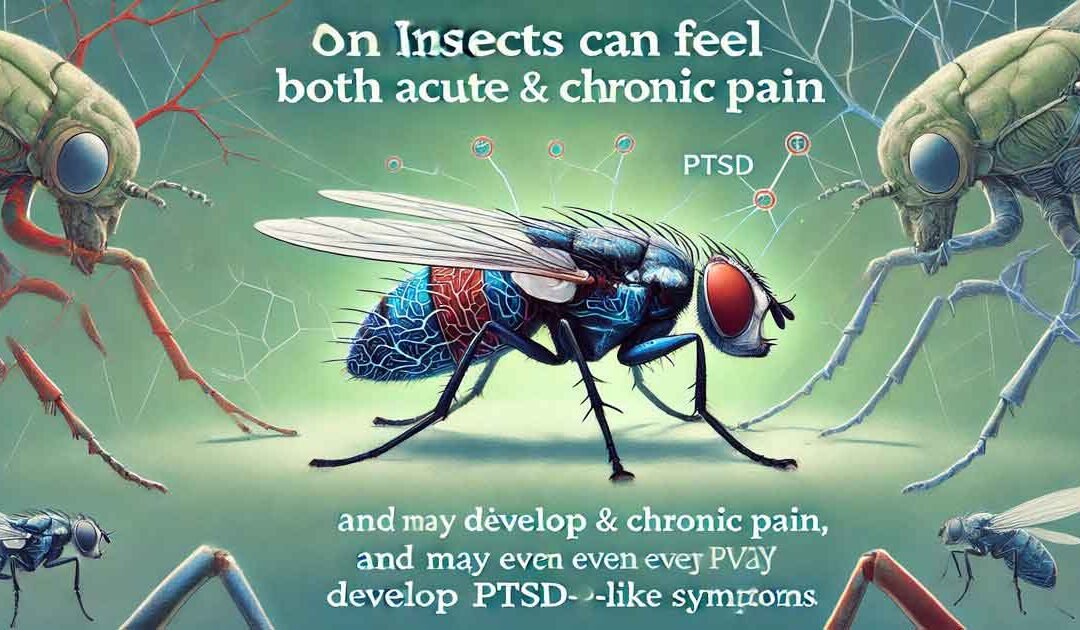
Not many of the readers of this blog know it, but to this day, baby surgeries or other painful procedures are often performed without anesthesia. The rationale for this horrific torture is that babies' nervous systems are not yet developed, so they do not feel pain. You'd have to be a special kind of sociopath to argue this when screaming, writhing babies are operated on, have needles inserted into their spinal cavities, have caustic skin procedures performed on them, etc. And while some scientists speak out against treating babies as brainless, numb matter, even these scientists usually readily subscribe to the theory that lower-level animals certainly don't feel pain. For this reason vivisection on live animals is considered perfectly justifiable.
The study below leads us to disagree with this. It shows that animals as „primitive“ as insects can feel both acute and chronic pain. Moreover, in the case of chronic pain, the insect may even develop something similar to post-traumatic stress disorder, in which it becomes hypervigilant and hypersensitive to its environment and senses danger everywhere and all the time. Studies like this make me think that maybe the insensitive doctors who make comments about others„ lack of pain should operate without anesthesia. Because the old Latin saying goes “eventus stultorum magister" - only experience can teach/change fools.
On a more positive note, the study found that chronic neuropathic pain results from the loss of pain „brakes“ - inhibitory signals in the nervous system that act to control/limit pain signals entering the CNS for processing. This discovery suggests that the loss of GABA/glycine signals may be the cause of chronic pain in humans, and this coincides quite well with the lifelong decline in GABA and glycine signals that began in the early 1930s. A person in their 80s probably only has half the ability to respond to GABA/glycine and this allows excitatory signals to rule unchecked. No wonder old people can never relax and although they are always tired, they cannot sleep deeply and the vast majority report experiencing some chronic pain. Perhaps the solution is as simple as eating gelatin daily or using a little progesterone...
https://www.cell.com/abstract/S0092-8674(03)00272-1
https://advances.sciencemag.org/content/5/7/eaaw4099
“...Scientists have known insects experience something like pain since 2003, but new research published today from Associate Professor Greg Neely and colleagues at the University of Sydney proves for the first time that insects also experience chronic pain that lasts long after an initial injury has healed. The study in the peer-reviewed journal Science Advances offers the first genetic evidence of what causes chronic pain in Drosophila (fruit flies) and there is good evidence that similar changes also drive chronic pain in humans. Ongoing research into these mechanisms could lead to the development of treatments that, for the first time, target the cause and not just the symptoms of chronic pain.”
“...In the study, Associate Professor Neely and lead author Dr Thang Khuongfrom the University's Charles Perkins Centre, damaged a nerve in one leg of the fly. The injury was then allowed to fully heal. After the injury healed, they found the fly's other legs had become hypersensitive. “After the animal is hurt once badly, they are hypersensitive and try to protect themselves for the rest of their lives,” said Associate Professor Neely. “That's kind of cool and intuitive.”
“The fly is receiving ‘pain’ messages from its body that then go through sensory neurons to the ventral nerve cord, the fly's version of our spinal cord. In this nerve cord are inhibitory neurons that act like a ‘gate’ to allow or block pain perception based on the context,” Associate Professor Neely said. “After the injury, the injured nerve dumps all its cargo in the nerve cord and kills all the brakes, forever. Then the rest of the animal doesn't have brakes on its ‘pain’. The ‘pain’ threshold changes and now they are hypervigilant.”
“Animals need to lose the ‘pain’ brakes to survive in dangerous situations but when humans lose those brakes it makes our lives miserable. We need to get the brakes back to live a comfortable and non-painful existence.” In humans, chronic pain is presumed to develop through either peripheral sensitisation or central disinhibition, said Associate Professor Neely. “From our unbiased genomic dissection of neuropathic ‘pain’ in the fly, all our data points to central disinhibition as the critical and underlying cause for chronic neuropathic pain.” “Importantly now we know the critical step causing neuropathic ‘pain’ in flies, mice and probably humans, is the loss of the pain brakes in the central nervous system, we are focused on making new stem cell therapies or drugs that target the underlying cause and stop pain for good.”
Source:
- Яжте по 3 ябълки или круши на ден и отслабнете с няколко килограма
- Ограничаването на приема на цистеин и метионин може да помогне за лечението на затлъстяването, без да се налага увеличаване на физическата активност
- Революционен поглед върху рака: Метаболитен, а не само генетичен проблем
- Хидроксиапатит в оралната грижа: Преглед на ползите, механизма и сравнение с флуорида
- How many fresh oranges do you need to cleanse your liver of fat?